The goal
A lot of Farsight happens in the rain. When you come back inside, you track water in with you, so the floor quietly shows where you've been.
How it works
A script keeps track of how wet your shoes are. Each print is a URP decal with a shoe sole texture, 8.5 by 22 cm, projected down onto whatever floor is underneath.
A print only darkens the floor's colour where the sole touched. It doesn't change how shiny the floor is. The game uses deferred rendering, so URP draws the prints as G-buffer decals: they're written into the floor's colour before lighting, and the room's lights then treat them as part of the floor.
1. Soaking and drying
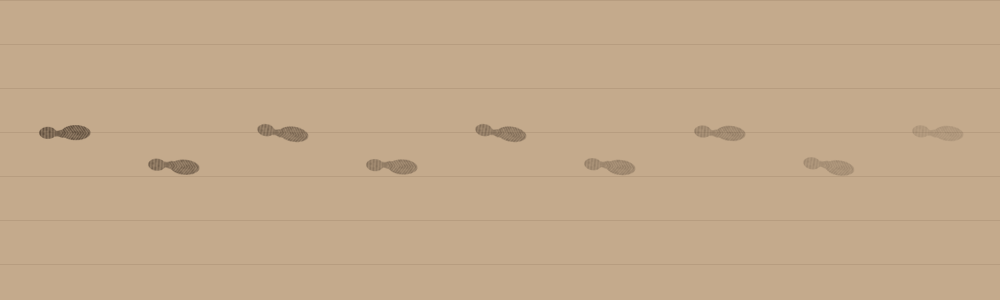
Being outside gets your shoes wet, and they're soaked through in about two and a half seconds. The house already keeps track of whether you're inside or out, and the script reads that. Once you're inside, the wetness drops with distance walked, and after about 14 metres your shoes are dry and stop leaving prints.

2. Placing a print
Every 42 cm you walk indoors, the next foot puts down a print. Feet sit 6.5 cm either side of where you're walking, and the left foot is just the right sole flipped.
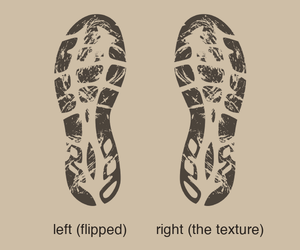
Each print gets a few degrees of random turn, plus a little toe-out, so the trail doesn't look too perfect. Its strength follows how wet your shoes still are, with a small random variation from print to print.
Each print goes on the nearest floor below you, ignoring your own collider, and tilts to match the floor's slope.
3. The pool
Prints don't dry on their own. There's a fixed pool of 120, which is nearly four full trails, and when they run out the oldest print is moved to the new spot.
The diagrams were drawn with Python from the script's numbers and the game's sole texture.